
Kitchen Utensils and Equipment: What to Buy First
A kitchen can look fully stocked and still fail you on a Tuesday night. The usual problem is not a shortage of tools; it is the wrong mix of utensils and equipment for the way you actually cook. A giant set can still be useless if it misses a sharp knife, a thermometer, and tongs.
The best kitchen setup is not the biggest one. It is the one that matches task, heat source, batch size, and cleanup time. That is why this guide focuses on kitchen utensils and equipment and their uses in real cooking, not just a pretty list of names.
For readers searching for the right basics, the answer is simple: buy tools that cut, measure, mix, heat, serve, and store food well, then skip the clutter that looks impressive but rarely earns counter space. If you want a budget-friendly starting point, see our guide to best cheap kitchen utensils.
The kitchen kit that actually earns its shelf space
Featured snippet answer: Kitchen utensils and equipment are the tools used to prepare, cook, serve, and store food. Utensils include knives, spoons, spatulas, and tongs; equipment includes stoves, ovens, mixers, and blenders. Each item helps with cutting, measuring, mixing, heating, or serving food efficiently.

The real test is not how many pieces you own. It is whether each item saves time, improves control, or prevents mistakes. A tool that does none of those things is just drawer clutter. That sounds harsh, but it is the truth.
The 5 jobs every kitchen tool must perform
Every useful kitchen tool performs one or more of five jobs: cut, measure, mix, heat, and serve. If a tool does not help with one of those jobs faster or better than your hands alone, it probably does not deserve a permanent spot.
- Cut: chef’s knife, paring knife, serrated knife, peeler, kitchen shears
- Measure: measuring cups, measuring spoons, kitchen scale, liquid measuring jug
- Mix: whisk, spoon, spatula, hand mixer, stand mixer
- Heat: stove, oven, microwave, air fryer, pressure cooker
- Serve: tongs, ladle, slotted spoon, serving spoon
A simple task-to-tool match keeps you honest. Tomatoes need a sharp serrated knife, not a blunt utility blade. Pancake batter needs a whisk or blender, not a fork. A nonstick pan needs silicone or wood, not a metal spatula that tears the coating. That changes everything.
What professionals buy first vs. what beginners overbuy
Pros usually start with fewer tools, not more. A good knife, a stable cutting board, a thermometer, a saucepan, and a skillet will outperform a cheap 12-piece set that feels complete but cooks poorly. Beginners often buy matching sets because they look organized. They are organized. They are just not efficient.
Practical buying tiers:
- Starter kit: 1 chef’s knife, 1 paring knife, 1 spatula, 1 whisk, 1 tongs, 1 saucepan, 1 skillet, 1 measuring set
- Mid-range durable kit: add a kitchen scale, Dutch oven, sheet pan, blender, and instant-read thermometer
- Pro-style kit: add a food processor, stand mixer, stockpot, sieve, and dedicated storage containers
Dishwasher-safe convenience matters, but edge retention and material durability matter more if you cook often. A knife that dulls fast is not a bargain. A flimsy whisk that bends in thick batter is not “lightweight”; it is underbuilt.
Utensils by function, not by aisle
Organizing by function makes shopping easier and cooking faster. It also keeps you from buying three versions of the same thing in different colors. The aisle layout is for stores. Your kitchen should be arranged around tasks.
Cutting and trimming
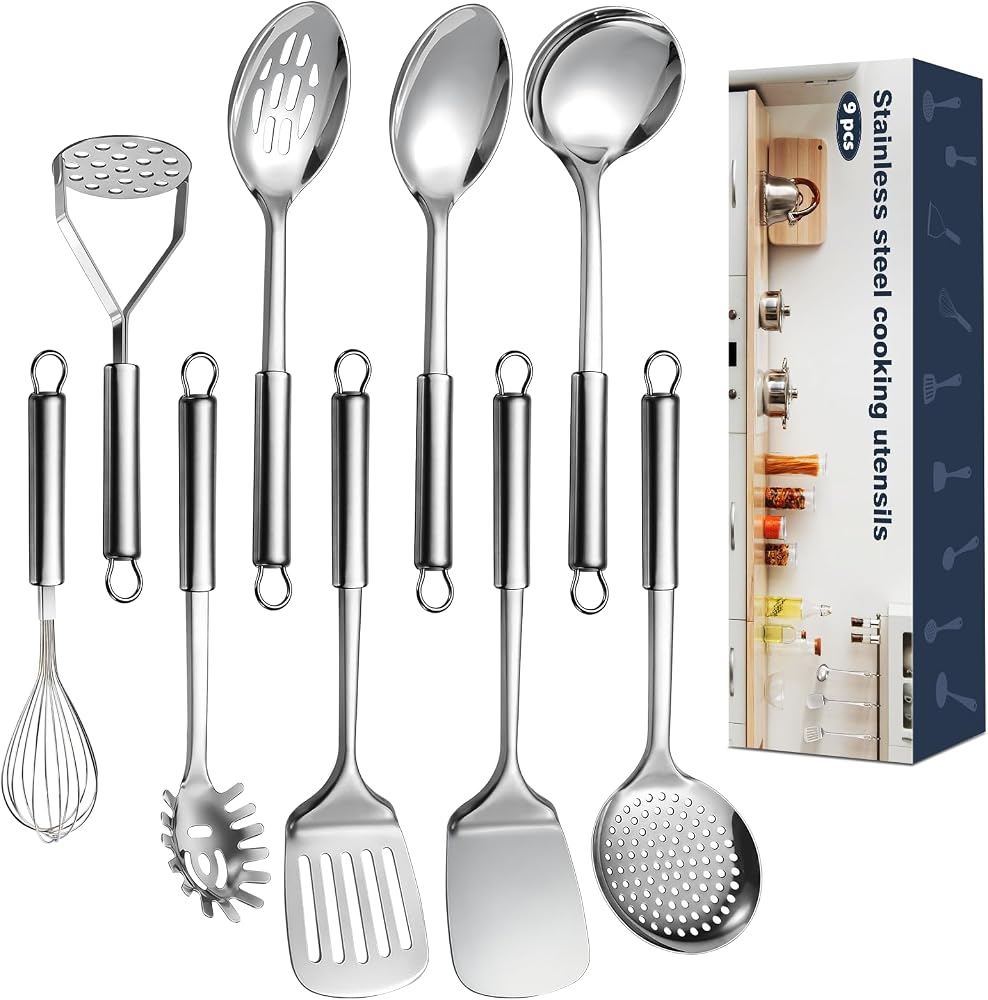
A sharp knife does more for cooking quality than almost any other hand tool. The standard chef’s knife is usually 8 to 10 inches long, or about 20 to 25 cm, and handles most chopping, slicing, and mincing jobs. A paring knife handles small fruit, herbs, and trimming work. A serrated knife cuts bread, tomatoes, and soft-skinned produce without crushing them.
- Chef’s knife: main prep knife for vegetables, meat, herbs, and general slicing
- Paring knife: peeling, trimming, coring, and detail work
- Serrated knife: bread, tomatoes, citrus, and soft crusts
- Peeler: removes thin skins from potatoes, carrots, apples, and cucumbers
- Kitchen shears: herbs, poultry packaging, bacon, and light trimming
Material note: stainless steel resists rust and is easier to maintain; high-carbon steel usually holds an edge longer but needs more care. Handle balance matters too. If the knife feels heavy at the blade or awkward at the heel, you will avoid using it. That is how kitchens become chaotic.
If you are still choosing your core prep gear, it helps to read what kitchen utensils are essential before spending on extras you do not need yet.
Mixing, folding, and scraping
The right mixing tool depends on texture. A balloon whisk traps air for eggs, cream, and vinaigrettes. A flat whisk reaches pan corners and works well for gravies and roux. A silicone spatula scrapes bowls clean and folds batter without deflating it. A wooden spoon handles thick mixtures and does not scratch most cookware.
- Balloon whisk: aerates eggs, cream, and sauces
- Flat whisk: better for shallow pans and gravies
- Silicone spatula: folding, scraping, and nonstick-safe stirring
- Wooden spoon: thick sauces, stews, and stovetop cooking
- Ladle: soups, broths, and liquid portioning
Silicone spatulas are usually heat-resistant up to about 400 to 600°F depending on the model, which is plenty for most home cooking. The real advantage is not just heat tolerance. It is non-scratch performance on coated pans and clean scraping in mixing bowls. People on cooking forums complain less about “not enough tools” and more about tools that leave half the batter behind. They are right.
Measuring and portioning
Measuring cups and spoons are fine for casual cooking, but a kitchen scale is more accurate for baking and batch prep. Volume measurements can vary with ingredient packing, humidity, and how you fill the cup. Grams do not care about your scoop technique.
- Measuring cups: dry ingredients like flour, sugar, rice
- Measuring spoons: small amounts of salt, baking powder, spices, vanilla
- Kitchen scale: baking, portion control, and recipe consistency
- Liquid measuring jug: broth, milk, oil, and water
A digital scale with 1-gram increments is enough for most home kitchens. For baking, that precision is worth far more than another gadget drawer full of specialty tools. Metric and imperial conversions still trip people up, so pick one system and stay consistent inside a recipe.
Equipment that changes outcomes, not just convenience
Equipment is where cooking quality really changes. Utensils help you work. Equipment changes heat, texture, timing, and capacity. A better stove, oven, or mixer can improve results even if your knives are ordinary.

Heat source and cooking vessels
The stove and oven are the backbone of most kitchens. A gas range gives fast visual heat control, while electric and induction models tend to offer steadier simmering and easier cleanup. Ovens usually need 10 to 20 minutes to preheat, though convection models often recover heat faster after the door opens. Microwaves are best for reheating and fast steaming, not browning.
- Stove: searing, sautéing, boiling, simmering
- Oven: baking, roasting, broiling
- Microwave: reheating, melting, quick steaming
- Pressure cooker: beans, tough cuts, fast braises
- Air fryer: crisping small batches with faster preheat
For speed cooking, an air fryer can be useful, but it does not replace a real oven. It is a small, high-airflow cooker with a limited batch size. For searing, a heavy skillet on a strong burner still beats most countertop gadgets. No contest.
Prep machines that save labor
Blenders, food processors, mixers, and grinders reduce labor in different ways. A blender is best for liquids and smooth textures. A food processor is better for chopping, shredding, and dough mixing. A hand mixer handles cakes and whipped mixtures without the footprint of a stand mixer. A grinder is for spices, coffee, or meat, depending on the design.
- Blender: smoothies, soups, sauces, purees
- Food processor: chopping, shredding, slicing, dough, nut butters
- Hand mixer: batters, whipped cream, frosting
- Stand mixer: bread dough, cookie dough, heavy batters
- Grinder: spices, coffee, meat, and dry ingredients
Motor power usually ranges from about 200 watts for basic hand mixers to 800 watts or more for stronger blenders and processors. Capacity matters as much as wattage. A powerful machine with a tiny bowl still forces you to work in batches. That is not always a dealbreaker, but it is a real trade-off. Storage footprint matters too, especially in small apartments.
Storage and preservation
Good storage equipment protects food and reduces waste. Airtight containers keep dry goods from absorbing moisture and odors. Fridge bins improve visibility. Freezer-safe containers slow freezer burn. Foil, wrap, and reusable lids each have a job, but none is magic on its own.
- Airtight containers: dry food storage, leftovers, meal prep
- Foil and wrap: short-term covering, lining, freezing
- Fridge/freezer bins: organization and stackability
- Labels: date tracking and rotation
Separate wet and dry storage whenever possible. Salsa does not belong next to flour, and raw meat juices should never share space with ready-to-eat food. Clean organization is not just tidy. It is safer.
The “buy this first” hierarchy for real kitchens
If you are building from scratch, start with the tools that affect most meals. This is the part where people waste the most money. They buy specialty gadgets before they own the basics that make daily cooking easier.

Minimum kit for a small home kitchen
The smallest useful kit is surprisingly compact. You do not need a drawer full of gadgets to cook well. You need a few reliable tools that cover most meals.
- 1 chef’s knife
- 1 paring knife
- 1 cutting board
- 1 saucepan
- 1 frying pan
- 1 spatula
- 1 whisk
- 1 measuring set
- 1 instant-read thermometer
The thermometer beats extra gadgets because it prevents undercooked chicken, overcooked steak, and guesswork with baked goods. A $15 to $25 instant-read model usually does more for results than a decorative gadget that gets used twice a year.
If you cook daily, upgrade these next
Daily cooking changes the math. Batch size, durability, and cleanup time matter more once you are cooking most nights. The next upgrades should reduce labor or expand what you can cook comfortably.
- Dutch oven: braises, soups, stews, bread
- Sheet pan: roasting vegetables, baking, meal prep
- Tongs: flipping, turning, serving
- Sieve or strainer: rinsing, draining, dusting
- Kitchen scale: baking and portions
- Blender: sauces, smoothies, soups
Stainless steel usually outlasts nonstick for high-heat and heavy-use tasks, while nonstick is easier for eggs and delicate foods. Use each where it makes sense. Trying to make one pan do everything is how coatings get ruined early.
What to skip unless you cook a specific cuisine
Skip single-use gadgets unless you know exactly how often you will use them. Garlic presses, avocado slicers, banana cutters, egg separators, and novelty choppers are classic drawer-fillers. Some are fine. Most are unnecessary. Storage space is expensive, even if the gadget itself is cheap.
If a tool only handles one task and that task is easy to do with an existing knife or spoon, it is probably not worth the money. The same rule applies to specialty presses and oversized sets with duplicate pieces. One good tool beats three mediocre ones.
Material matters more than marketing
Material choice affects heat tolerance, cleaning, lifespan, and safety. A tool can look premium and still be the wrong material for the job. The label matters less than how the item behaves after 50 uses.
Stainless steel, silicone, wood, cast iron, nonstick
Each material has a best use and a clear downside. The trick is matching material to task instead of chasing a “best overall” fantasy that does not exist.
| Material | Best use | Downside | Cleaning notes |
|---|---|---|---|
| Stainless steel | Spatulas, bowls, pans, tongs, prep tools | Can scratch delicate coatings | Dishwasher-safe in most cases; dry to avoid water spots |
| Silicone | Spatulas, baking tools, stirring on nonstick | Lower-end versions can stain or feel floppy | Wash well; check for trapped residue in seams |
| Wood | Spoons, salad servers, gentle stirring | Needs drying and oiling; can crack | Hand wash; do not soak for long periods |
| Cast iron | High-heat searing, baking, long heat retention | Heavy; needs seasoning | Dry immediately; oil lightly after cleaning |
| Nonstick | Eggs, fish, pancakes, delicate food | Shorter lifespan; avoid high heat and metal tools | Use soft sponges; replace when coating flakes or peels |
Wood is still a smart choice for many cooks, but not all wood utensils are equal. Some bamboo products can splinter or dry out faster if they are poorly finished. If you want a deeper look at that issue, read bamboo cooking utensils dangers.
Safety and hygiene basics people miss
Kitchen safety is mostly boring, which is why people ignore it until something goes wrong. Cross-contamination, dull blades, and cracked handles cause more problems than most “advanced” cooking techniques ever will.
- Cross-contamination: use separate boards or wash thoroughly between raw meat and ready-to-eat food
- Heat-safe handles: check pan handle ratings before oven use
- Knife storage: use a block, sheath, or magnetic strip
- Food-grade plastic: replace when it warps, cracks, or stains deeply
Replacement timing: nonstick pans often need replacement when the coating flakes, scratches deeply, or loses release performance. Spatulas should go when edges curl or seams trap grime. Knives should be sharpened regularly, not “eventually.”
Common mistakes that make “good” utensils perform badly
Most kitchen failures come from misuse, not bad branding. A good tool used badly will still produce bad results. That is why “I bought the nice one” is not the same as “I use it correctly.”
Owning too many tools
Too many tools slow you down. They crowd drawers, take longer to wash, and make it harder to grab the right item quickly. Duplicate tools rarely improve cooking. They usually just create decision fatigue.
A lean kitchen is faster to clean and easier to keep organized. You can still own specialty gear, but it should earn its place through frequent use, not novelty.
Using the wrong tool for the job
Metal on nonstick shortens pan life. A dull knife crushes tomatoes instead of slicing them cleanly. An oversized whisk in a small bowl splashes batter everywhere. These are small errors, but they add up fast.
- Wrong knife: dull edge causes slipping and uneven cuts
- Wrong utensil material: metal can damage coated cookware
- Wrong size: large tools in small bowls waste effort and create mess
Home cooks on forums say the same thing over and over: the annoying part is not the cooking, it is the cleanup caused by the wrong tool choice. They are not wrong.
Ignoring maintenance
Maintenance is the part people skip, then blame the tool. Sharpen knives. Wash and dry pans properly. Descale appliances if your water is hard. Check seals, lids, and blades before they fail mid-recipe.
- Knife sharpening: every few months for regular home use, more often for heavy prep
- Cast iron seasoning: after washing and drying, apply a thin oil layer
- Appliance cleaning: remove residue from blender gaskets and processor lids
- Seal checks: replace worn blender rings, lids, and rubber components
A neglected tool often feels “bad” long before it actually wears out. Maintenance usually fixes what replacement would have cost much more to solve.
Quick-reference chart: utensil, equipment, and their uses
This chart gives you the fast answer most people want when they search kitchen utensils and equipment and their uses. It is also the easiest way to compare what each item does, what it is made from, and what goes wrong when people buy the wrong version.
Task-based comparison table
| Item | Main use | Best material | Common mistake | Buy priority |
|---|---|---|---|---|
| Chef’s knife | Chopping, slicing, mincing | High-carbon stainless steel | Buying too many cheap knives | High |
| Paring knife | Trimming and small cuts | Stainless steel | Using it for heavy chopping | High |
| Spatula | Folding, scraping, flipping | Silicone | Using metal on nonstick | High |
| Whisk | Mixing and aerating | Stainless steel | Using one that is too large for the bowl | High |
| Tongs | Turning, lifting, serving | Stainless steel with silicone tips | Buying flimsy spring-loaded models | High |
| Peeler | Removing skins | Stainless steel blade | Using a dull blade that wastes produce | Medium |
| Stove | Heating, simmering, searing | Gas, electric, or induction | Ignoring burner size and heat control | High |
| Oven | Baking and roasting | Insulated steel cavity | Skipping preheat time | High |
| Blender | Purees, smoothies, sauces | Glass or BPA-free pitcher | Overfilling or using it dry | Medium |
| Mixer | Batters and doughs | Metal beaters and sturdy motor housing | Trying to knead heavy dough with a weak unit | Medium |
| Scale | Accurate measuring | Digital platform | Relying on cups for baking precision | High |
| Thermometer | Food safety and doneness | Instant-read digital probe | Guessing meat temperatures | High |
What a smart kitchen setup looks like in practice
A smart kitchen setup is not about owning everything. It is about owning the right combination for your cooking style. If you cook quick weeknight meals, your money should go to knives, pans, tongs, a thermometer, and a scale before it goes to specialty appliances. If you bake often, the priorities shift toward scales, mixers, sheet pans, and reliable measuring tools.
The best setups also respect cleanup time. Silicone tools on nonstick pans, stackable containers, and durable stainless steel pieces can save you minutes every day. Those minutes matter. They add up faster than most people expect.
People Also Ask: kitchen utensils and equipment and their uses
These are the direct answers people usually want after searching kitchen utensils and equipment and their uses. The short version is simple: choose tools by task, not by appearance, and buy the items that improve accuracy, safety, and speed.
Kitchen utensils and equipment and their uses?
Kitchen utensils and equipment are the tools used for preparing, cooking, serving, and storing food. Utensils include knives, spoons, spatulas, tongs, whisks, and peelers; equipment includes stoves, ovens, blenders, mixers, scales, and thermometers. Each one supports a specific cooking task.
Kitchen tools utensils and equipment and their uses?
Kitchen tools, utensils, and equipment are used to cut, measure, mix, heat, and serve food. Tools like knives and peelers handle prep, utensils like spatulas and whisks handle mixing and cooking, and equipment like ovens and blenders handle larger or more complex tasks.
What kitchen utensils are essential?
The essential kitchen utensils are a chef’s knife, paring knife, spatula, whisk, tongs, measuring cups or scale, cutting board, and instant-read thermometer. Those items cover most everyday cooking without wasting money on specialty gadgets.
What is the difference between kitchen utensils and equipment?
Utensils are hand tools you use directly, such as spoons, knives, and tongs. Equipment is larger or powered gear such as stoves, ovens, mixers, blenders, and refrigerators. Utensils usually help with manual tasks, while equipment changes heat, speed, or capacity.
Which kitchen tools should I buy first?
Buy a sharp chef’s knife, paring knife, cutting board, saucepan, frying pan, spatula, whisk, measuring set, and thermometer first. If you cook often, add tongs, a Dutch oven, a scale, and a blender next. Skip novelty gadgets until the basics are covered.
Why is a kitchen scale better than measuring cups for baking?
A kitchen scale is better because it measures by weight, which is more accurate than volume. Flour, sugar, and other dry ingredients can pack differently in cups, but grams stay consistent. That improves repeatability and reduces recipe failures.
What kitchen equipment is most important for beginners?
The most important beginner equipment is a stove, oven, saucepan, skillet, cutting board, knife, thermometer, and measuring tools. Those items handle the widest range of meals with the least clutter.
If you want a more focused shopping path after reading this guide, the next best step is to compare your current drawer against a true essentials list. That is where a guide like what kitchen utensils are essential becomes useful as a second pass, especially if you are trying to build a lean kitchen without overspending.