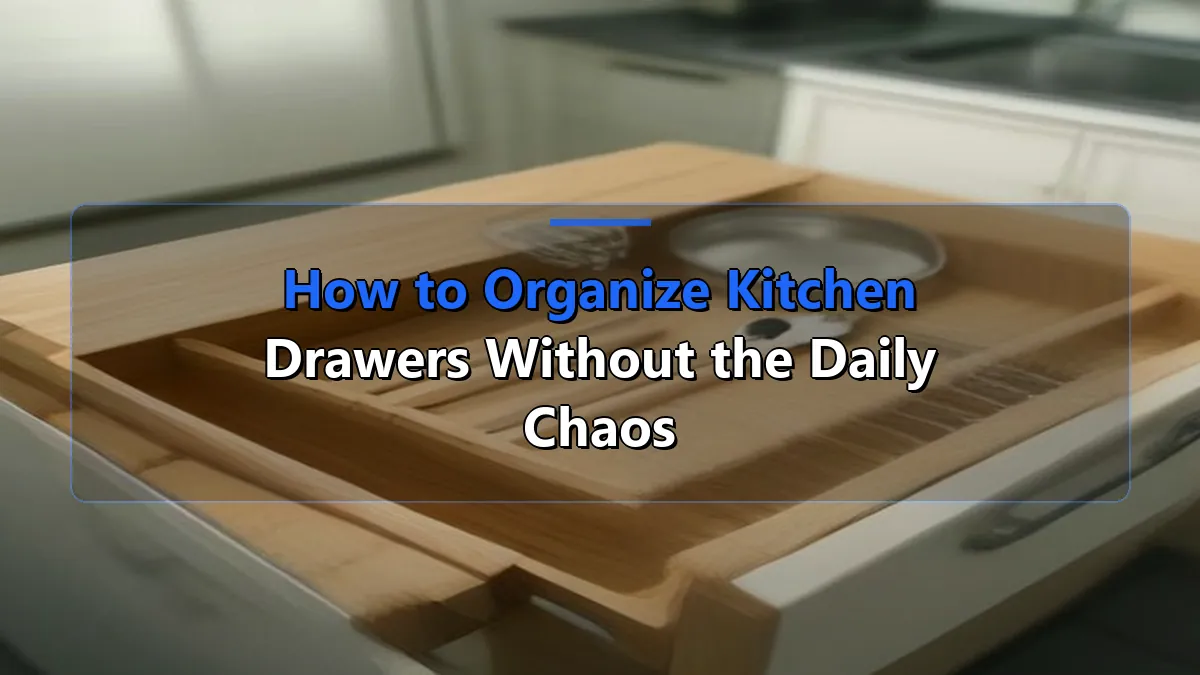
How to Organize Kitchen Drawers Without the Daily Chaos
Most kitchen drawers fail for the same reason support menus do: too many options and no clear path to the right one. If you’ve ever opened a drawer and found spatulas, takeout chopsticks, rubber bands, and three mystery peelers tangled together, you don’t have a storage problem—you have a speed problem.
The fix is not prettier bins for the sake of it. The fix is a drawer system built around how you actually cook: one job per drawer, one category per zone, and the most-used tools in the easiest reach. That setup cuts search time, stops duplicate buys, and stays usable after the first week.
Think of it like reliable messaging on your phone: the goal is fast, clear access without extra tapping. A good drawer setup should do the same thing for your kitchen. It should help, not slow you down.
Start with a drawer audit, not a shopping trip
The best way to organize kitchen drawers is to empty them first, measure the usable interior space, and sort items by how often you reach for them. That gives you a layout that fits your real cooking habits instead of a Pinterest version of your kitchen. Most standard kitchen drawers are about 18 to 24 inches wide, 18 to 22 inches deep, and 2 to 6 inches tall inside, but the usable space is usually smaller once slides and fronts are factored in.

Do the audit in this order:
- Empty one drawer at a time.
- Measure interior width, depth, and height.
- Group items into daily, weekly, and rare-use piles.
- Remove duplicates and broken tools.
- Only then buy organizers.
That last step matters. People often buy a tray first, then try to force the drawer to fit the tray. That’s backwards. The drawer is the constraint.
Measure usable space, not just exterior dimensions
Usable space is the interior width minus side rails, the interior depth minus the back wall gap, and the interior height minus any lip or drawer front overlap. A shallow drawer with 2.5 to 3 inches of clearance works well for utensils and flat tools. A deep drawer with 5 to 7 inches of clearance can handle vertical bins, but only if the items stay upright.
| Drawer type | Typical interior height | Best use | Organizer style |
|---|---|---|---|
| Shallow drawer | 2 to 3 inches | Flat utensils, measuring tools, peelers | Low-profile tray or dividers |
| Standard drawer | 3 to 5 inches | Everyday cooking tools, bag clips, small gadgets | Expandable tray or modular bins |
| Deep drawer | 5 to 7+ inches | Bulky tools, knife blocks, vertical storage | Deep bins, inserts, standing dividers |
Measure twice. Buy once. That saves money and frustration.
Sort by frequency, not by object type
Daily-use items belong in the easiest drawer access zone, weekly-use items can go one step farther, and rare-use items should leave the drawer entirely. That “one-touch access” rule is the whole system. If you have to move three things to reach the thing you need, the drawer is poorly organized.
Here’s the practical split I use in real kitchens:
- Daily-use: spatula, tongs, chef’s knife, vegetable peeler, measuring spoons, whisk
- Weekly-use: garlic press, zester, can opener, thermometer, pastry brush
- Rare-use: cookie cutters, extra corkscrews, specialty tools, backup gadgets
Reddit users often say a drawer system fails when every utensil gets its own tiny bin. They’re right. Too much segmentation turns the drawer into a puzzle. Keep the layout simple enough to reset in two minutes.
Build a drawer map around cooking behavior
Organize drawers by workflow: prep near prep, cooking near the stove, and cleanup near the sink or dishwasher. That layout cuts reach time because your tools live where your hands already go. It also reduces the “I know I own one somewhere” problem that leads to duplicate buying.

If your kitchen has only three usable drawers, assign them like this:
- Prep drawer: knives, peelers, measuring spoons, measuring cups, scissors
- Cook drawer: spatulas, tongs, ladles, thermometers, whisks
- Cleanup drawer: trash bags, foil, parchment, zip bags, dish tabs, clips
That setup works better than sorting by “utensils,” “gadgets,” and “miscellaneous.” Those labels sound tidy, but they do not match how people cook. Your kitchen should support the work, not the taxonomy.
Put prep tools where prep actually happens
Prep tools should live in the drawer closest to the main cutting board or prep counter. Knives, peelers, microplanes, measuring spoons, and kitchen shears are the highest-frequency prep items in most homes. If you use them every day, they deserve prime real estate.
For knives, use a drawer insert or blade-safe tray. A loose knife rolling around in a drawer is a bad idea, full stop. It dulls edges, scratches everything else, and increases cut risk when you reach in fast.
If you cook a lot, this is also where a smart upgrade helps. A well-chosen organizer can be more useful than buying another gadget, and if you need ideas, the list of kitchen gadgets can help you sort what earns drawer space and what should stay out of the drawer entirely.
Keep cleanup tools near the sink or dishwasher
Cleanup tools belong where cleanup happens. Foil, parchment paper, sandwich bags, trash bags, and dishwasher tabs are easiest to use when they sit near the sink, dishwasher, or trash pull-out. That reduces the “walk across the kitchen for a zip bag” problem that wastes time every single day.
A lot of people store these items in a pantry drawer because it looks tidy. I’d skip that unless your pantry is directly adjacent to the kitchen work zone. Otherwise, you’re just adding steps.
Use the right organizer for the drawer depth
Shallow drawers need low-profile trays, standard drawers work best with expandable inserts, and deep drawers need bins that keep items upright without tipping. The organizer should fit the drawer’s height with a little breathing room, not cram it full. If the organizer is too tall, the drawer will jam or the contents will snag every time you open it.

Here’s the practical comparison:
| Organizer type | Best drawer depth | Strength | Weak spot |
|---|---|---|---|
| Bamboo tray | Shallow to standard | Looks clean, easy to wipe down | Fixed compartments can waste space |
| Expandable divider tray | Standard | Adjusts to drawer width | Can shift if poorly fitted |
| Modular bins | Standard to deep | Flexible layout for mixed tools | Too many bins create friction |
| Vertical insert | Deep | Good for standing tools and knives | Can hide small items |
Shallow drawers need flat, low-profile separators
Shallow drawers should stay under about 2 inches of organizer height if you want the drawer to close cleanly. Flat trays are best for measuring spoons, peelers, bag clips, and small whisks. If you try to force deep bins into a shallow drawer, you lose usable clearance fast.
Use adjustable dividers if your utensils vary in length. They let you set lane widths without wasting space. That matters more than matching colors or material.
Deep drawers work better with vertical bins
Deep drawers are useful, but only if you control the wobble. Vertical bins work well for spatulas, wooden spoons, rolling pins, and kitchen towels, but they need enough base weight or side support to stay upright. If the bin is too light, it slides every time you open the drawer.
My rule: if the item tips when the drawer shuts, it does not belong standing up in that drawer. Simple. Honest. Effective.
Decide what belongs in drawers vs cabinets
Drawers should hold fast-grab items only; bulky, seasonal, or awkward items usually belong in cabinets. That split keeps drawers efficient and prevents them from turning into a dumping ground. A drawer is a speed zone. A cabinet is a storage zone. Those are not the same thing.

Move these out of drawers when space is tight:
- Mixing bowls
- Small appliances
- Bulk packaging
- Extra bakeware
- Rare holiday tools
If you’re trying to make a small kitchen work harder, that shift can recover a surprising amount of space. In many homes, moving just three bulky items out of drawers frees up enough room for the tools you actually use every day. If you need more ideas for the rest of the kitchen, see best kitchen gadgets for disabled people for reach-friendly tools that reduce strain and make drawer access easier.
Keep drawers for fast-grab items only
Fast-grab items are the ones you use without thinking: tongs, spatulas, measuring spoons, can opener, peeler, dish towels. These are the tools that benefit most from a drawer because they need one-step access and repeat use.
Anything you use less than once a month is a candidate for a cabinet, pantry bin, or upper shelf. That’s not harsh. It’s efficient.
Move bulky or seasonal items out
Seasonal cookie cutters, holiday serving tools, and rarely used gadgets should not sit in prime drawer space. If they only appear a few times a year, they’re stealing access from items that matter every day.
One practical trick: store seasonal items together in a labeled bin in a cabinet, then reassess after the holidays. If you didn’t miss it, it probably doesn’t deserve drawer space.
The 15-minute system that prevents relapse
A weekly two-minute reset and a strict one-in-one-out habit keep kitchen drawers from sliding back into chaos. Organization fails when maintenance is too complicated. The best system is the one you’ll actually repeat while making coffee or waiting for pasta water to boil.
Here’s the reset routine:
- Take 60 seconds to return items to their zones.
- Remove duplicates that have crept in.
- Wipe crumbs and dust from the tray.
- Check one drawer only each week, not the whole kitchen.
That’s it. No marathon overhaul. No weekend project. Just enough maintenance to keep the system alive.
Use a weekly 2-minute drawer reset
Pick one day and reset the most-used drawer first. If that drawer stays clean, the rest of the kitchen usually follows. A quick wipe with a damp cloth and a dry towel is enough for most trays and dividers. Bamboo and wood inserts should stay dry; standing water warps them over time.
If you want a broader home reset, pair this habit with a simple best kitchen gadgets for elderly guide when you’re choosing tools that are easy to grip, easier to store, and less likely to become drawer clutter.
Stop duplicate accumulation at the source
Duplicate tools are one of the biggest reasons drawers fail. Most kitchens don’t need three can openers, four spatulas, or a backup garlic press. If you already own one working version, the extra one is just future clutter.
A good rule: if you buy a replacement, remove the old one the same day. That habit is the kitchen version of turning a feature on or off cleanly instead of letting both versions run at once. Keep the system simple. Don’t enable chaos.
Real-life drawer layouts that actually work
The right layout depends on household size, cooking style, and how much drawer space you really have. A small apartment, a family kitchen, and a serious home cook’s kitchen need different setups. Copying someone else’s drawer map without adapting it is how people end up with beautiful but useless storage.
Small apartment kitchen
A small apartment kitchen usually works best with one utility drawer, one prep drawer, and one catchall-free drawer. That means you keep the most-used items in the easiest access points and force the rest into a cabinet or pantry.
- Utility drawer: scissors, tape, batteries, bag clips
- Prep drawer: peeler, measuring spoons, spatula, whisk
- Cleanup drawer: foil, parchment, zip bags, dish tabs
If your apartment kitchen feels boxed in, the real fix may be better storage choices, not more containers. A broader list of kitchen gadgets can help you decide which compact tools earn a drawer spot and which ones should stay in a cabinet.
Family kitchen
Family kitchens need repeatability. A lower drawer for kid-safe items, a snack drawer, and a lunch-packing drawer usually works well. The lower drawer should hold plastic cups, kid utensils, and snack clips, not sharp tools or fragile gadgets.
Parents on forums often say the system works only when kids can find and return things without help. That’s true. If your family can’t maintain it, the layout is too complicated.
Serious home cook
A serious home cook usually benefits from a knife drawer insert, a prep station drawer, and a baking drawer. That setup keeps frequently used tools grouped by task instead of by randomness. It also prevents the “everything is in the same drawer” problem that slows down cooking flow.
For a cook who bakes often, measuring tools and rolling pins should live together. For a cook who sears and sautés, tongs, thermometers, and spatulas should be grouped together. Match the drawer to the habit.
Common mistakes that make drawers fail
The biggest drawer mistakes are over-dividing, storing rare items in prime space, and choosing containers that waste inches. These errors make drawers look organized for a week, then they fall apart because the system is too fussy to use.
Too many bins create friction
Every extra bin creates a tiny barrier to putting something away. That friction adds up. If you need to lift three containers to reach one spoon, the drawer is failing at its core job.
Use fewer containers than you think you need. One well-fitted tray is often better than six tiny bins.
Pretty containers that waste inches
Pretty organizers can be a trap. Rounded corners, thick walls, and decorative edges eat storage space fast. In a drawer, every inch matters. A modular plastic or bamboo system that fits tightly usually beats a pretty tray with dead space around the edges.
That trade-off is not glamorous, but it is real. Pretty does not equal practical.
Quick answers to the most searched questions
What is the best way to organize kitchen drawers? The best way is to assign each drawer one job, keep only daily-use items inside, and use dividers or bins that match the drawer’s depth and width. Start with the most-used tools, not the nicest-looking ones.
How to organize kitchen drawers and cabinets? Put fast-grab items in drawers and bulky or seasonal items in cabinets. Drawers should hold prep tools, cooking tools, and cleanup supplies. Cabinets should hold mixing bowls, small appliances, and rare-use items.
How to organize kitchen drawers reddit? Reddit advice usually lands on the same point: keep the system simple, avoid over-splitting categories, and do not buy too many bins. The most useful setup is the one you can reset quickly after a busy week.
How do I keep kitchen drawers from getting messy again? Use a weekly two-minute reset, remove duplicates immediately, and stop storing random overflow in the nearest drawer. If an item has no clear home, it’s a sign the drawer map needs adjustment.
What should I put in the top kitchen drawer? Put the most-used, lightest, and safest items in the top drawer: measuring spoons, peelers, spatulas, scissors, bag clips, and utensils you reach for every day. Keep sharp or heavy items in a more controlled setup.
Should I organize drawers before cabinets? Yes. Drawers are the fastest access points in most kitchens, so they have the biggest daily impact. Once the drawers are working, cabinet storage becomes easier to plan around them.
People also ask
What is the best way to organize kitchen drawers? Use one drawer per task, store daily-use items in the easiest reach zone, and choose organizers that fit the drawer’s exact dimensions. That gives you speed, not just neatness.
How to organize kitchen drawers? Empty the drawer, measure it, sort items by frequency, remove duplicates, then install a tray or divider that matches the depth. Put the most-used tools where your hand naturally lands first.
How to organize kitchen drawers and cabinets? Keep drawers for quick-access tools and cabinets for bulky, seasonal, or rarely used items. That division keeps the kitchen efficient and reduces clutter in the spots you use most.
How to organize kitchen drawers reddit? The most common Reddit advice is to keep it simple, avoid too many compartments, and build the drawer around your actual cooking routine. If the system is hard to maintain, it will fail.
What should not go in kitchen drawers? Oversized appliances, bulk packaging, rarely used gadgets, and fragile items that can shift around should usually stay out of drawers. They take up space better used by everyday tools.
How often should I reorganize kitchen drawers? Do a full reset every 6 to 12 months and a quick two-minute tidy each week. That keeps the layout usable without turning organization into a chore.