WAYNE WaterBUG Pump Review: Will It Drain Your Hot Tub?
A hot tub’s built-in drain can turn a routine water change into an afternoon of watching a hose. The WAYNE WaterBUG WWB looks like an appealing shortcut: set it in the spa, attach a garden hose, and let it pump. The question isn’t just how quickly it moves water. It’s how much it leaves behind on a curved tub floor.
This WAYNE WaterBUG submersible pump review for draining hot tubs focuses on that practical trade-off. Its advertised 1,350-gallon-per-hour maximum sounds fast, and its shallow-water pickup sounds useful, but neither number tells you exactly how your hose run will perform.
Affiliate disclosure: If you buy through the Amazon links below, we may earn a commission at no extra cost to you. No hands-on drain test or verified customer-complaint dataset was supplied for this review; timing estimates are calculations, not claimed test results.
Quick verdict: WAYNE WaterBUG WWB
Best for: Spa owners who drain periodically and want a pump that can pick up shallow water on flat portions of the shell. Watch out for: A long or uphill garden-hose run, water trapped around molded seats, and the need to switch the pump off before it runs dry. It’s a sensible spa-draining tool, not a promise of an empty, towel-dry tub.

Can the WAYNE WaterBUG drain a hot tub?
Yes, the WAYNE WaterBUG can drain a hot tub, but its 1,350-GPH rating describes favorable conditions, not a long garden hose. A 400-gallon spa takes about 18 minutes in theory; expect longer. Use GFCI protection, keep the intake submerged, and check permitted water temperature first.
That’s the short answer. The more useful question is whether the WWB fits your particular tub: where it can sit flat, where the hose needs to go, and how you’ll remove the final puddles.
The specs that matter for spa draining
WAYNE markets the WaterBUG as a general water-removal pump, not a hot-tub-specific appliance. These are the supplied WWB product claims most relevant to a spa water change. Confirm operating limits against the instructions packaged with your pump before use.
| Specification | Details |
|---|---|
| Model | WAYNE WaterBUG WWB |
| Advertised maximum flow | Up to 1,350 gallons per hour; not a guaranteed rate through your garden hose |
| Advertised minimum water pickup | Down to 1/16 inch under suitable conditions on a flat surface |
| Discharge choices | Top or side outlet, selected to suit the space and hose route |
| Hose connection | Outlets designed to fit a standard garden hose |
| Intake | Multi-ring suction strainer intended to keep larger debris out |
| Outlet parts | Plastic discharge outlets with tethered cap seals |
| Shutoff consideration | Product information says to unplug the pump once the water is gone; don’t assume it can run dry unattended |
| Assembly claim | Assembled in the USA, according to the supplied listing |
The published maximum flow and 1/16-inch pickup figure describe different aspects of performance. Neither is a measured result from a filled spa with a hose stretched across the yard.
What a 400-gallon drain actually looks like
Here’s the tempting calculation: 400 gallons ÷ 1,350 gallons per hour × 60 = about 18 minutes. Treat that as a mathematical floor based on the advertised maximum, not an appointment you can put on the calendar.
A garden hose adds friction, especially if it’s narrow, kinked, or long. Pumping to ground higher than the water level adds vertical lift. As the spa empties, you may also need to reposition the pump to keep its intake covered. Without a documented test showing starting volume, hose diameter and length, lift, and elapsed time, a precise “400-gallon drain time” would be made up.
For your own setup, lay out the shortest practical hose route before starting. Keep bends gentle, and make sure the discharge end leads somewhere you’re permitted to send spa water. If you’re planning a water change from start to finish, our hot tub draining guide covers the rest of the job; our pump hose-sizing guide explains why hose choice changes the result.
Build quality and ergonomics: two outlets solve a real problem
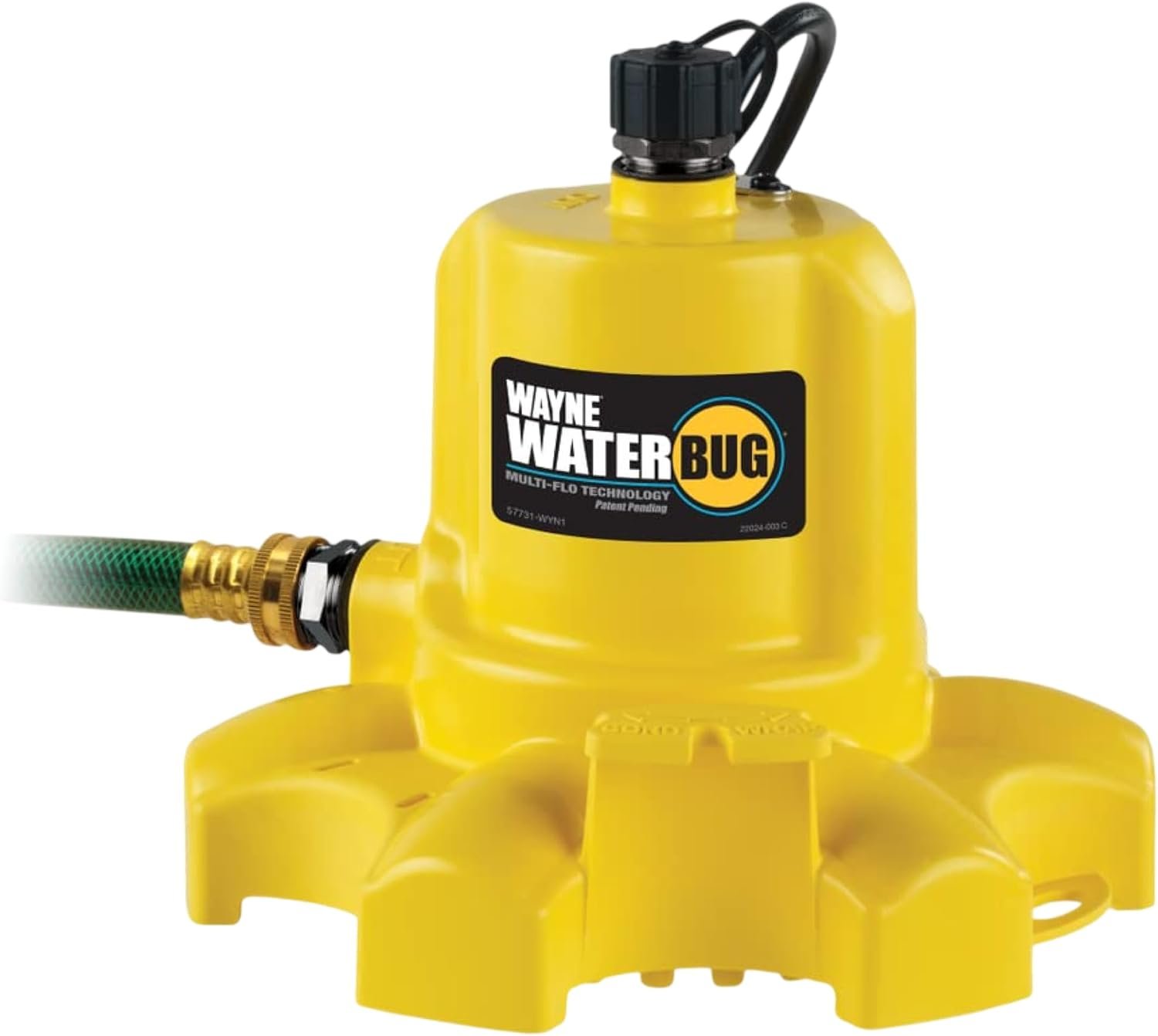
The WaterBUG’s most useful design choice for a hot tub is its selectable top or side discharge. The top outlet can make hose routing less awkward in a confined footwell. The side outlet gives you another route when the pump sits on a broad, open section of the shell. The tethered caps are a small but welcome detail: loose caps are easy to misplace during a messy water change.
There’s a trade-off. The outlets are plastic, so forcing a hose fitting onto crooked threads is a poor idea. Thread the hose on by hand, check that the unused outlet is sealed as directed, and position the hose so its weight doesn’t tug the pump off its intended spot.
The multi-ring strainer should help keep stray leaves and other larger debris away from the intake. It doesn’t make the pump a substitute for cleaning the tub first. Hair, grit, and small debris still deserve attention, particularly if the spa has been sitting uncovered.
The last inch is where it earns, or loses, its place
The advertised 1/16-inch pickup is attractive. A hot tub floor, though, isn’t the flat test surface that figure brings to mind. Molded seats, a recessed footwell, drain fittings, and the slope toward low spots can prevent the pump from sitting where the last water collects.
In practice, plan to move the pump as the level falls, but only while handling it according to the manufacturer’s safety instructions. Don’t reach into the water to reposition a powered pump. Once the intake begins drawing air or the pump can no longer remain properly submerged, switch it off and unplug it. Finish isolated puddles with a towel or an appropriate wet/dry vacuum.
Don’t leave it running while you do another chore. The supplied product information specifically warns that the pump should be unplugged once the water is gone. That matters more than squeezing a few extra drops from the shell.
Three checks before you put it in treated water
Hot-tub draining involves electricity, warm water, and a discharge location. Sort out all three before plugging in the pump.
- Electrical setup: Use GFCI-protected power and follow the WWB instructions for its cord and connections. Keep the plug and every electrical connection dry and out of the water. No one should be in the spa while the pump operates. See our hot-tub GFCI safety guide for the broader precautions.
- Water temperature: “Submersible” does not mean “approved for any temperature.” Confirm the permitted water-temperature range in the instructions for your exact pump before draining a still-hot spa. If the water exceeds that limit, let it cool first; don’t substitute a safe bathing temperature for a pump rating.
- Disposal: Check local rules before sending chlorinated or brominated spa water into a storm drain, street gutter, or planted area. The acceptable destination and any required treatment vary by municipality. Our spa-water disposal guide is a starting checklist, not a replacement for local guidance.
For product-specific operating limits, use the instructions supplied with the WWB or request the current manual from WAYNE. General electrical guidance from the U.S. Consumer Product Safety Commission cannot override the pump’s instructions.
Pros, cons, and the complaints to take seriously
The supplied product data reports a 4.5-out-of-5-star rating but includes no written buyer complaints, review count, or dated review sample. I can’t responsibly claim that a particular failure is common. The drawbacks below are practical limitations of this setup, not invented quotations from owners.
| ✅ Pros (What We Liked) | ⚠️ Cons (What Could Be Better) |
|---|---|
| Advertised pickup down to 1/16 inch on a suitable flat surface | A contoured spa shell can still leave water around seats and recesses |
| Top and side outlets offer useful hose-routing choices | Hose length, diameter, and uphill routing can cut actual flow below the headline rating |
| Connects to a standard garden hose | Plastic outlet threads and caps deserve careful handling |
| Strainer helps keep larger debris away from the intake | You still need to watch the water level and unplug before dry running |
How it compares to other ways to empty a spa
These ratings are editorial assessments of fit for a typical periodic hot-tub water change, not head-to-head test scores. Actual drain speed depends on the installation and discharge route.
| Model | Best For | Key Advantage | Rating |
|---|---|---|---|
| WAYNE WaterBUG WWB | Owners who value shallow-water pickup and flexible hose routing | Two discharge positions; advertised pickup down to 1/16 inch on a flat surface | 4/5 for hot-tub fit, conditional on temperature and hose setup |
| Spa’s built-in drain | Occasional draining with no extra equipment | Lowest setup effort and no pump to store | 3/5 for hot-tub fit; speed varies by spa and hose |
| Higher-capacity submersible utility pump (model varies) | Owners prioritizing bulk-water removal | Potentially higher flow if the chosen model and discharge setup support it | 3/5 for hot-tub fit; shallow-water finish varies by model |
Who should buy it, and who should skip it?
Buy it if you empty your spa periodically, have a sensible garden-hose route, and would appreciate a pump designed to pick up shallow water where it can sit flat. The two outlet positions make the WWB particularly appealing if your footwell leaves little room to aim a hose.
Skip it if you need a guaranteed drain time, must push water a long way uphill, or expect the pump to empty every curved recess without a towel. Also skip using it on still-hot water until you’ve checked the exact model’s permitted temperature. If you can’t supervise the final stage and unplug it before it runs dry, this isn’t the right set-and-forget job.
Final verdict
The WAYNE WaterBUG WWB makes sense as a supervised hot-tub draining pump, especially for owners frustrated by the final shallow layer of water. Its top and side outlets are genuinely relevant to a cramped spa floor. Just keep the 1,350-GPH claim in perspective: it’s a maximum rating, not a timed result through your hose.
I’d choose it for manageable hose runs and periodic water changes, with a towel ready for the molded low spots. Check the manual’s temperature and electrical instructions first, decide where the treated water can legally go, and stay nearby as the tub empties.
Check Latest Price on Amazon →
Frequently asked questions
These are the practical questions to settle before the next water change.
How long will a WAYNE WaterBUG take to drain a 400-gallon hot tub?
About 18 minutes is the calculation at its advertised 1,350-GPH maximum. Actual time will be longer if the hose, vertical lift, or pump placement reduces flow. There’s no verified 400-gallon spa test time in the information supplied for this review.
Will the WaterBUG completely empty a hot tub?
Don’t count on it. The advertised 1/16-inch pickup applies under suitable conditions on a flat surface. Seats, slopes, and drain recesses can leave puddles that need a towel or wet/dry vacuum.
Can I pump hot spa water with it?
Check the permitted water-temperature range in the instructions for your exact WWB before pumping. A pump being submersible does not establish its safe operating temperature. Let the spa cool if its water exceeds the stated limit.
Can I leave the WaterBUG running until the hot tub is empty?
No. The supplied product information says to unplug it once the water is gone so it doesn’t run dry. Stay close enough to switch it off when the intake starts drawing air or can no longer remain properly submerged.
Can hot-tub water go into a storm drain?
Don’t assume so. Municipal rules differ, particularly for water containing sanitizer. Check your local utility or public works guidance before choosing a discharge location.