
Complete Kitchen Utensils List: What to Buy, Keep, Skip
Most “complete lists” of kitchen utensils are just shopping lists wearing a lab coat. That’s not helpful when you’re trying to stock a real kitchen, avoid duplicates, or figure out which tools actually earn drawer space. The better approach is to sort utensils by job: prep, cook, serve, bake, and store.
This guide does exactly that. You’ll get the complete list of kitchen utensils, but also the part most people need and rarely get: what’s essential, what’s optional, what’s specialty-only, and which materials make sense for nonstick, stainless, and daily use. If you want the short version first, the answer is simple: buy the core tools, then add only what matches your cooking style.
If you’re building from zero, downsizing, or replacing a pile of mismatched gadgets, this is the decision-first version. And if you want a tighter buying shortlist after you read the list, see what kitchen utensils are essential for the lean version, or best cheap kitchen utensils if budget matters more than brand names.
What counts as a kitchen utensil—and what doesn’t
A kitchen utensil is a handheld tool used to prep, cook, serve, or measure food; cookware holds food over heat, and appliances use power to do the work. That simple rule keeps the list clean and prevents the usual chaos of mixing knives, pans, and blenders into one pile. It also explains why a whisk belongs here, but a Dutch oven does not.

Utensils vs. appliances vs. cookware
Handheld tools are utensils: spatulas, tongs, ladles, peelers, whisks, and measuring spoons. Cookware is the heat vessel: skillet, saucepan, stockpot, roasting pan. Appliances are powered gear: stand mixer, food processor, blender, toaster oven. That distinction matters because most kitchens do not need more gadgets; they need the right hand tools.
The “complete list” problem
The word complete changes depending on how you cook. A weeknight family kitchen may use 12 to 15 core utensils every week, while a fully equipped home kitchen can easily run past 35 tools once baking, grilling, and specialty cooking enter the picture. That’s normal. The trick is not owning everything. The trick is owning what actually gets used.
The essential core set most kitchens actually use every week
The core set is small, and that’s the point. If you cook regularly, these are the tools that solve 90% of daily tasks without cluttering every drawer. Most of the rest of the list is either specialty gear or nice-to-have backup.
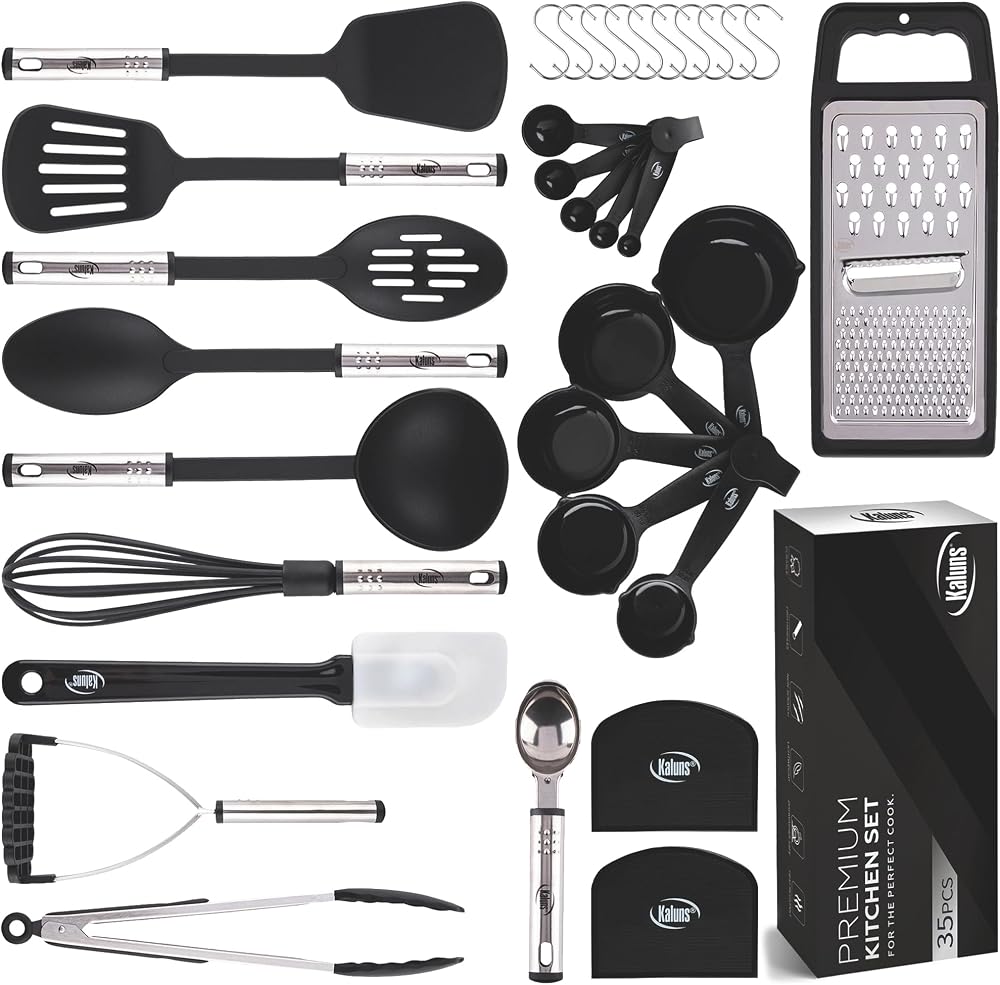
Prep essentials
These are the tools that get food ready before heat ever hits the pan:
- Chef’s knife — usually 8 to 10 inches; the main workhorse for chopping, slicing, and dicing.
- Paring knife — usually 3 to 4 inches; best for peeling, trimming, and small precision cuts.
- Cutting board — ideally 0.5 to 1 inch thick; wood or plastic both work, but a stable board matters more than the logo.
- Vegetable peeler — Y-peelers are fast and comfortable for most hands.
- Box grater — for cheese, vegetables, and coarse zesting.
- Microplane — best for citrus zest, garlic, nutmeg, and hard cheese.
- Measuring cups — dry sets for flour, sugar, rice, and oats.
- Measuring spoons — for spices, baking powder, salt, and extracts.
- Mixing bowls — a practical set usually includes 1.5-quart, 3-quart, and 5-quart bowls.
- Kitchen scale — especially useful for baking and portion control.
A 8-inch chef’s knife is the safest default for most home cooks. Bigger can feel clumsy if your board is tiny. Smaller can feel cramped if you prep a lot of produce.
Cook essentials
These are the tools that live near the stove:
- Spatula / turner — for flipping eggs, burgers, fish, and pancakes.
- Silicone spatula — for scraping bowls and folding batter.
- Wooden spoon — classic stirring tool for sauces, soups, and sauteing.
- Tongs — 9 to 12 inches is the sweet spot for most home kitchens.
- Whisk — balloon whisks are best for eggs, cream, and vinaigrettes.
- Ladle — for soups, stews, and broths.
- Slotted spoon — for lifting food out of liquid without dragging half the pot with it.
- Fish spatula — thin, flexible, and excellent for delicate foods.
Silicone tools are commonly heat-rated around 400 to 600°F, which covers most stovetop use. Wood does not melt, but it does absorb moisture and odor, so it needs better drying and a little more care. That’s the trade-off. Every tool has two sides.
Serve essentials
Serving tools keep the main cooking utensils from becoming serving utensils forever, which is how kitchens get messy:
- Serving spoon
- Serving fork
- Salad servers
- Soup ladle
- Pie server
- Serving tongs
If you host often, dedicated serving tools are worth the drawer space. If you don’t, a good spoon, ladle, and tongs can cover a lot of ground.
The full utensil inventory, grouped by task instead of alphabetically
This is the exhaustive version. Not every household needs every item, but this is the practical full inventory most U.S. kitchens eventually accumulate if they cook a lot.

Cutting and prep
- Chef’s knife
- Paring knife
- Serrated knife — for bread, tomatoes, and soft-skinned produce.
- Boning knife — for trimming meat and poultry.
- Kitchen shears — for herbs, packaging, poultry, and trimming.
- Vegetable peeler
- Mandoline — fast slicing for potatoes, cucumbers, and onions; use the guard.
- Zester
- Box grater
- Microplane
- Garlic press
- Avocado slicer — optional, and honestly easy to skip.
- Melon baller
- Kitchen twine cutter or snips
A mandoline can cut prep time dramatically, but it also increases cut risk. If you own one, use the guard every time. No exceptions. Most kitchen accidents happen in the last 10 seconds of a task.
Measuring
- Dry measuring cups
- Liquid measuring cup — usually marked in cups, ounces, and milliliters.
- Measuring spoons
- Kitchen scale
- Thermometer — instant-read for meat, candy, and bread.
- Timer
Dry and liquid measuring tools are not interchangeable. A liquid cup is meant to be filled to a line and read at eye level; dry cups are meant to be leveled off. That difference matters in baking, where a sloppy cup of flour can wreck texture.
Mixing
- Mixing bowls
- Whisk
- Fork
- Batter spoon
- Rubber spatula
- Wooden spoon
- Balloon whisk
- Flat whisk — useful for gravies and pan sauces.
Cooking and stirring
- Solid spoon
- Slotted spoon
- Spatula
- Fish spatula
- Tongs
- Ladle
- Skimmer — for foam and frying debris.
- Spider strainer — for lifting noodles, dumplings, and fried foods.
- Potato masher
- Slotted turner
For nonstick pans, silicone, wood, and nylon are the safer picks. Stainless steel lasts longer and feels better in the hand, but it can scratch coatings. That scratch is not cosmetic. It shortens the life of the pan.
Baking-specific utensils
- Pastry brush
- Rolling pin
- Dough scraper
- Bench scraper
- Pastry cutter
- Sifter
- Cookie scoop — common sizes range from 1 tablespoon to 3 tablespoons.
- Offset spatula — often 4 to 10 inches long.
- Cooling rack
- Pie server
Baking tools are where precision starts paying rent. A 2-tablespoon cookie scoop gives more even cookies than eyeballing by hand, and an offset spatula makes frosting and lifting far less annoying.
Specialty and regional tools
- Mortar and pestle
- Rice paddle
- Pasta server
- Citrus juicer
- Garlic press
- Herb scissors
- Tortilla press
- Ricer — for smooth mashed potatoes and some gnocchi work.
- Nutcracker
- Cherry pitter
- Olive pitter
- Tea infuser
These are great if you cook those foods often. If not, they become drawer clutter fast. A garlic press, for example, is beloved by some cooks and ignored by others. That’s normal, not a moral failure.
What to buy first if you’re building from zero
Start with the tools that solve the most tasks per dollar. Buying a giant set is usually cheaper upfront, but it often includes duplicates, weak scissors, and one weird gadget you’ll never touch again. Individual pieces cost more at checkout and less in regret.

The 12-item starter kit
- Chef’s knife
- Cutting board
- Paring knife
- Vegetable peeler
- Measuring cups
- Measuring spoons
- Mixing bowl set
- Silicone spatula
- Wooden spoon
- Tongs
- Whisk
- Ladle
That list handles chopping, stirring, flipping, measuring, and serving in a normal week. If you cook eggs, pasta, soups, sheet-pan dinners, and simple sauces, it covers almost everything.
The upgrade tier
Add these only after you notice the gap:
- Fish spatula if you cook delicate fillets or pancakes often.
- Microplane if you use citrus zest, garlic, or Parmesan weekly.
- Kitchen scale if you bake or portion food.
- Instant-read thermometer if you cook meat, candy, or bread.
- Mandoline if you slice vegetables in volume.
- Offset spatula if you bake cakes or decorate desserts.
If you want a more focused shopping path, the right next step is usually a guide to what kitchen utensils are essential. It keeps you from buying a drawer full of tools that look useful but never leave the tray.
Materials matter more than the tool name
The same tool shape can behave very differently depending on material. A wooden spoon, silicone spatula, and stainless steel spoon all stir, but they do not wear the same, clean the same, or last the same. That choice matters more than people think.
Silicone vs. wood vs. stainless steel vs. plastic
| Material | Best For | Strengths | Weaknesses |
|---|---|---|---|
| Silicone | Spatulas, scrapers, spoonulas | Heat resistant, nonstick safe, flexible, dishwasher friendly | Can feel floppy if low quality; cheap versions stain |
| Wood | Spoons, turners, salad tools | Gentle on cookware, comfortable grip, no metal-on-pan noise | Porous, can absorb odor and moisture, needs hand drying |
| Stainless steel | Tongs, whisks, ladles, strainers | Durable, hygienic, long life, good for high heat | Can scratch nonstick, gets hot, often louder and heavier |
| Plastic / nylon | Budget spatulas, spoons, turners | Inexpensive, light, nonstick friendly | Warps sooner, can discolor, lower heat tolerance |
For everyday cooking, silicone and stainless steel cover most needs. Wood is still excellent, especially for stirring and serving. Plastic is fine if the budget is tight, but it usually ages out first.
Nonstick cookware compatibility
Metal tools can scratch nonstick coatings, and once that coating is damaged, the pan loses some of the reason you bought it. Use silicone, wood, or nylon for coated pans. Save stainless steel for cast iron, stainless pans, and tasks where scratch risk does not matter.
Food safety and maintenance
Wooden utensils should be hand-washed and dried fully. If they crack, splinter, or keep holding odor after washing, replace them. Silicone tools last longer, but cheap seams can trap grime. Stainless steel usually outlasts everything else, which is why it shows up in commercial kitchens so often.
Quick checklist: what’s essential, optional, and niche
This is the fast scan section. If you are trying to decide what to keep, what to buy, or what to skip, use this table and move on with your day.
| Category | Examples | Status |
|---|---|---|
| Prep | Chef’s knife, paring knife, cutting board, peeler, measuring cups, measuring spoons, mixing bowls | Essential |
| Cook | Spatula, tongs, whisk, wooden spoon, ladle, slotted spoon | Essential |
| Serve | Serving spoon, soup ladle, salad servers, pie server | Helpful |
| Bake | Rolling pin, pastry brush, offset spatula, dough scraper, cookie scoop | Helpful if you bake |
| Specialty | Rice paddle, tortilla press, melon baller, cherry pitter, pasta server | Only if you use them |
Essential
If you only buy one tier, buy this one. It covers most cooking without clutter.
Helpful
These tools earn their spot if you cook often, host, or bake on weekends. They are not mandatory on day one.
Only if you cook specific cuisines
Rice paddles, tortilla presses, mortar and pestles, pasta servers, and citrus juicers make more sense when you cook those foods regularly. That’s not niche for the sake of niche. It’s just honest tool selection.
Materials, durability, and replacement timing
Most kitchen utensils fail in predictable ways: warped plastic, cracked wood, bent tongs, dulled edges, or loose handles. If a tool no longer feels stable in the hand, replace it. Don’t wait for it to fail mid-task.
- Plastic/nylon spatulas often wear out first, especially near heat.
- Wooden spoons last years if hand-washed and dried fully.
- Silicone spatulas can last a long time if the core is solid and the seam is well made.
- Stainless steel tongs and whisks often last the longest.
If you’re curious why some premium tools use copper or copper-colored construction, there’s a useful material guide on why is copper used in cooking utensils. The short version: heat behavior and responsiveness are the selling points, not just looks.
Complete list of kitchen utensils by category
Below is the full inventory in one place, grouped for scanning. This is the closest thing to a kitchen drawer master list.
Prep
- Chef’s knife
- Paring knife
- Serrated knife
- Boning knife
- Kitchen shears
- Cutting board
- Vegetable peeler
- Mandoline
- Zester
- Box grater
- Microplane
- Garlic press
- Melon baller
- Avocado slicer
- Cherry pitter
Measuring
- Dry measuring cups
- Liquid measuring cup
- Measuring spoons
- Kitchen scale
- Thermometer
- Timer
Mixing
- Mixing bowls
- Whisk
- Balloon whisk
- Flat whisk
- Fork
- Batter spoon
- Rubber spatula
- Wooden spoon
Cooking
- Solid spoon
- Slotted spoon
- Spatula
- Slotted turner
- Fish spatula
- Tongs
- Ladle
- Skimmer
- Spider strainer
- Potato masher
Baking
- Pastry brush
- Rolling pin
- Dough scraper
- Bench scraper
- Pastry cutter
- Sifter
- Cookie scoop
- Offset spatula
- Cooling rack
- Pie server
Serving
- Serving spoon
- Serving fork
- Salad servers
- Soup ladle
- Pie server
- Serving tongs
Specialty
- Mortar and pestle
- Rice paddle
- Pasta server
- Citrus juicer
- Tortilla press
- Ricer
- Nutcracker
- Herb scissors
- Tea infuser
- Olive pitter
Who should skip specialty utensils?
Skip specialty utensils if you cook a narrow range of everyday meals and already feel short on storage. A melon baller is fun; it is not essential. A tortilla press is great for homemade tortillas; it is dead weight if you never make them. That’s the honest cutoff.
People who bake, make fresh pasta, cook regional dishes, or entertain often will get more value from specialty tools. People who want a cleaner, simpler kitchen should stick to the core set and stop there.
People also ask
Complete list of kitchen utensils?
A complete list of kitchen utensils includes prep tools, measuring tools, mixing tools, cooking tools, serving tools, baking tools, and specialty tools. The core items are chef’s knife, cutting board, peeler, measuring cups, whisk, spatula, tongs, wooden spoon, ladle, and mixing bowls.
What are the 10 most useful kitchen utensils?
The 10 most useful kitchen utensils are a chef’s knife, cutting board, paring knife, vegetable peeler, measuring cups, measuring spoons, mixing bowls, spatula, tongs, and whisk. Those ten cover most daily cooking tasks in a normal home kitchen.
Which utensils are best for nonstick pans?
Silicone, wood, and nylon are the best utensils for nonstick pans because they are less likely to scratch the coating. Stainless steel is better saved for cast iron or stainless cookware.
Do I need specialty utensils?
No, not unless you cook the matching foods often. Specialty utensils are useful for specific tasks, but they should earn their place through repeated use, not novelty.
Auto-Generated SEO JSON-LD Schema