Can Wooden Spoons Go in the Dishwasher? The Real Trade-Off
Wooden spoons are not automatically dishwasher-safe, and the ones that survive a cycle or two can still come out drier, rougher, and a little more tired each time. The real enemy is repeated heat, detergent, and long drying time, not one dramatic failure. That’s why some spoons look fine for months and then suddenly split.
This is less like a permission question and more like a durability question. In the same way “can” has a dictionary definition, a modal verb meaning, and a plain English meaning that depends on context, this kitchen question depends on the spoon’s wood, finish, and how often you run the machine. The practical answer is simple: hand-washing is safest.
If you want the shortest version: most wooden spoons should not go in the dishwasher. A few dense, well-finished spoons may tolerate an occasional top-rack cycle, but that is not the same as being truly dishwasher-safe. Below, I’ll show you what actually happens to the wood, which spoons last longer, and how to keep a favorite spoon from turning into a fuzzy splinter factory.
The short answer: dishwasher-safe in theory, risky in practice
Usually, no—wooden spoons should not go in the dishwasher. Repeated heat, water, and detergent can cause swelling, cracking, warping, and rough fibers. Some coated or teak spoons may tolerate an occasional cycle, but hand-washing is the safest way to preserve the spoon and its finish.

Dishwashers typically run wash water around 120–160°F and heated dry cycles often push past 150°F. That’s enough heat, combined with alkaline detergent and repeated wet-dry cycling, to shorten the life of almost any wooden utensil. One cycle might not wreck a spoon. Ten cycles often will.
If you absolutely must use the dishwasher, keep the spoon on the top rack, skip heated dry, and pull it out as soon as the cycle ends. Then towel it dry right away. That’s damage control, not best practice.
What actually damages wood
Wood is hygroscopic, which means it absorbs and releases moisture from the air and from wash water. Each time a spoon gets soaked, heated, and dried, the fibers expand and contract. That movement is what opens tiny cracks, raises grain, and eventually warps the shape.
Detergent matters too. Dishwasher detergent is designed to cut grease aggressively, and that same chemistry strips natural oils from wood. Once the surface dries out, the spoon gets rougher faster. Rough wood is harder to keep clean, and that changes everything.
Long drying time is the third problem. A spoon that sits wet in a closed dishwasher, or in a damp utensil basket, stays in the danger zone longer. Moisture lingers in the grain, especially at the bowl end and around the handle joint if the spoon is laminated or glued.
Why some wooden spoons survive and others fail fast
Dense hardwoods hold up better than soft, porous woods, but none of them are truly dishwasher-proof. Beech, maple, olive wood, and teak all behave differently under heat and moisture, and the finish often matters more than the species. A thick spoon with a simple one-piece build usually outlasts a thin, glued one.

Hardwood vs. softwood vs. teak
Teak usually has the best odds because its natural oils make it more moisture-resistant than many other woods. Maple and beech are common utensil woods because they’re dense and relatively stable. Olive wood is beautiful and hard, but decorative grain and irregular density can mean more movement over time.
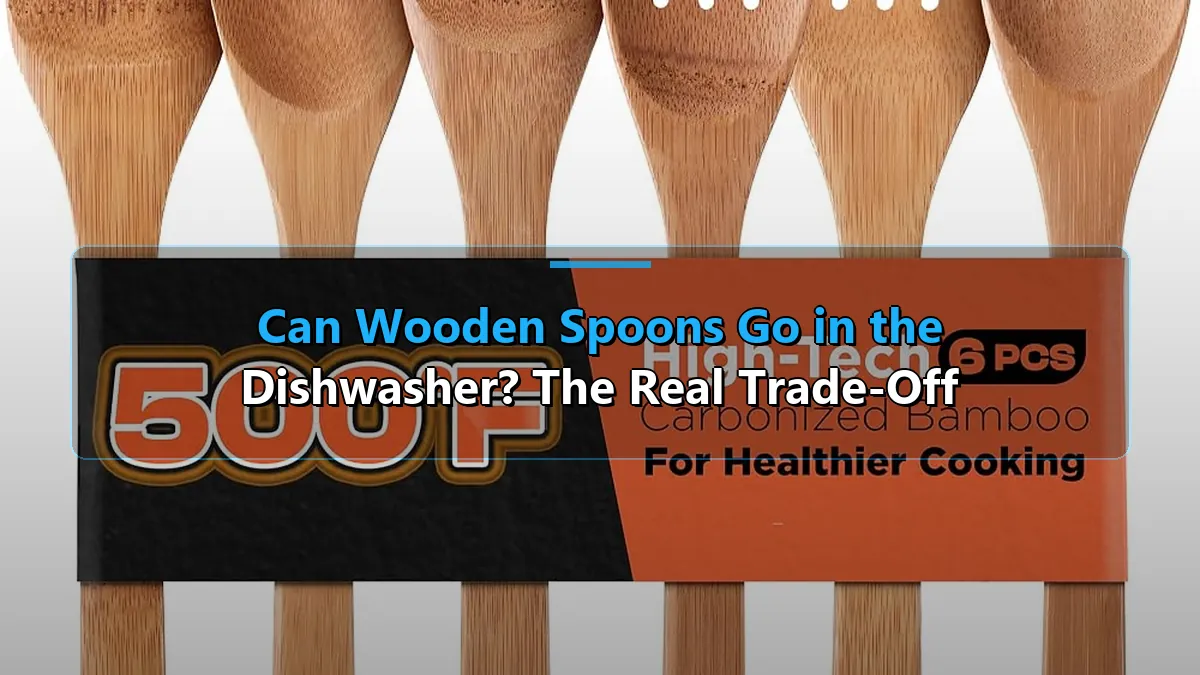
The real difference is porosity and construction. A thick, one-piece hardwood spoon absorbs less water than a thin spoon made from multiple glued parts. Bamboo is its own category: it is technically a grass, often laminated, and that glue line can fail in a dishwasher long before the bamboo itself does.
| Material / Build | Dishwasher Tolerance | Main Risk | Best Use |
|---|---|---|---|
| Beech wood | Low to moderate | Drying out, rough grain | Everyday hand-washed spoons |
| Maple | Low to moderate | Warping after repeated cycles | General cooking utensils |
| Olive wood | Moderate | Surface checking, cosmetic wear | Serving and light cooking |
| Teak | Moderate to better than average | Detergent wear over time | Frequent-use utensils |
| Bamboo, laminated | Low | Delamination at glue lines | Hand-wash only |
| Painted or lacquered wood | Low | Peeling, clouding, finish failure | Decorative use only |
Finish matters more than people think
A spoon finished with food-safe mineral oil or beeswax can resist moisture better than bare wood, but that finish is not a force field. A lacquered or coated spoon may look protected at first, then cloud, peel, or flake after a few hot cycles. Cosmetic failure often shows up before structural failure.
That’s why a spoon that “came out fine” once is a bad test. The finish may survive the first wash and still be losing protection underneath. If you care about the spoon, don’t wait for visible damage to make the decision for you.
The hidden cost of “it came out fine once”
One dishwasher cycle can leave a spoon looking only slightly dull, but repeated cycles build damage fast. The first signs are subtle: a little roughness, a paler color, a dry feel in the grain. After enough cycles, the spoon can splinter at the edge, cup at the bowl, or loosen at glued seams.

What damage looks like after 1 cycle vs. 10 cycles
After 1 cycle, expect minor dulling, a slightly raised grain, or a faintly dry surface. After 10+ cycles, the risk jumps to checking, end-grain splitting, handle warping, and a crumbly feel where the spoon meets the bowl. That’s the point where the tool stops feeling smooth in the hand.
Rough fibers are not just ugly. They trap residue more easily, which makes cleaning harder and sanitation less reliable. A spoon with visible checking or splintering should be retired or repurposed for dry ingredients only.
When to retire a spoon
Retire the spoon if you see deep cracks, persistent odor, splinters, or warping that changes how it sits in a pot or drawer. If the handle feels fuzzy even after washing, the surface has already degraded enough to matter.
Once wood becomes rough, cleaning gets less effective. That’s the practical line. Not sentiment. Not thrift.
Special cases people ask about
Some spoons deserve a closer look because the material or build changes the odds. The answer still leans toward hand-washing, but the details matter if you’re trying to decide whether a specific spoon gets a pass.

Can wooden cooking spoons go in dishwasher?
Same guidance: usually no. Thicker wooden cooking spoons can tolerate abuse a little longer because they have more material to lose before they deform. One-piece construction also helps. But thicker does not mean safe, and it definitely does not mean “wash it every day in the dishwasher.”
If a spoon is your everyday stirrer for sauces, soup, and pancake batter, hand-washing is the smarter routine. If you’re shopping for tools that are easier to manage with limited grip strength or mobility, the best cooking utensils for disabled roundup is a useful place to look for shapes and materials that reduce hassle.
Can teak wooden spoons go in the dishwasher?
Better odds, still not recommended. Teak’s natural oil content and moisture resistance give it an edge over many woods, so it may survive an occasional top-rack wash better than beech or pine. But detergent and heat still wear it down over time. That’s the catch.
Teak is the spoon material people point to online when they want permission to ignore the rules. I wouldn’t do that. If you want the spoon to last, the dishwasher should be the exception, not the routine.
What about bamboo spoons?
Bamboo spoons are often laminated, and the glue line is the weak point. High heat and moisture can cause delamination even if the bamboo fibers themselves stay intact. In plain English: the layers can separate.
If you use bamboo utensils because they feel lighter or easier to grip, think about the whole set, not just the spoon. The same logic that makes a spoon comfortable can make it fragile. For readers comparing utensil ergonomics, the best cooking utensils for visually impaired guide is a good companion read because high-contrast, easy-to-handle tools often overlap with low-maintenance ones.
Best care routine if you want wooden spoons to last years
The best maintenance routine is boring, fast, and effective: wash, dry, oil. That’s the whole playbook. Skip soaking, skip the dishwasher, and your spoons can last for years instead of months.
The 3-minute hand-wash method
Use warm water, a small amount of mild dish soap, and a soft sponge or cloth. Wash the spoon in under 60 seconds, rinse it well, towel it dry immediately, then stand it upright or lay it flat where air can reach both sides. Don’t leave it in a sink full of water. Don’t toss it in a wet utensil caddy and forget it.
Most owners who complain about warped spoons on forums made the same mistake: they let the spoon sit wet after washing. That’s usually more damaging than the wash itself. If you also keep wooden cutting boards, the same care logic applies; a good companion guide is how to clean wooden cutting boards without over-wetting them.
Oil schedule that actually helps
Apply food-grade mineral oil every few weeks if the spoon starts looking dry, or sooner if the wood turns pale and thirsty. A thin coat is enough; you do not need to drown the spoon. Wipe off the excess after 20 to 30 minutes so the surface doesn’t stay tacky.
Oil does not make wood dishwasher-safe. It just slows drying and reduces cracking. If your spoon is starting to feel rough, a restoration pass with oil is smart. If it’s already split, oil is too late.
If you need more help with maintenance, look for a guide on how to oil wooden utensils and a cleaner that is gentle on wood. Cheap, harsh products are a bad fit here. If you’re curious why some silicone tools get sticky over time, the related guide on why do silicone utensils get sticky explains the material side of kitchen-tool wear in a similar way.
Why this question gets confused with dictionary-style “can” searches
People search this phrase the way they search a dictionary definition or meaning Cambridge entry, meaning Merriam-Webster entry, or a free dictionary meaning lookup: they want a clean yes-or-no answer. But kitchen tools don’t work like a modal verb in English. The answer depends on condition, not grammar.
That’s why search results can feel oddly mixed, almost like a canva visual suite page sitting beside a dictionary definition meaning page. One result is about permission. The other is about something physical wearing down. This question is the second kind.
Bottom line: convenience vs. lifespan
If the spoon is cheap, plain, and you do not care if it wears out sooner, an occasional dishwasher cycle may be acceptable. If it’s a favorite spoon, a family hand-me-down, or a dense teak utensil you want to keep smooth, hand-wash it. That’s the honest trade-off.
Best practice: no dishwasher. Possible but not ideal: top rack, no heat dry, rare use. Worst case: thin, glued, cracked, unfinished, or painted wooden spoons. Those belong nowhere near a hot wash cycle.
Practical verdict: Wooden spoons can survive a dishwasher cycle, but survival is not the same as good care. If you want the spoon to stay smooth, clean, and usable for years, hand-washing wins every time.
People Also Ask
These are the direct, practical answers readers usually want after searching the question like a definition meaning lookup. Think of this as the kitchen version of a quick free dictionary check: short, direct, and specific.
Why can’t wooden spoons go in the dishwasher?
They can, but they usually should not. Dishwasher heat, detergent, and long drying cycles pull moisture in and out of the wood, which causes swelling, cracking, rough grain, and warping. The problem is repeated exposure, not one single wash.
Can wooden spoons go in the dishwasher?
Usually no. A few dense teak or heavily finished spoons may survive an occasional top-rack cycle, but hand-washing is the safer choice. If you want the spoon to last, wash it quickly by hand and dry it right away.
Can wooden cooking spoons go in dishwasher?
Same answer: usually no. Thicker wooden cooking spoons may tolerate abuse a little better than thin ones, but the dishwasher still shortens their life. If the spoon is glued, painted, or unfinished, skip the machine entirely.
Can teak wooden spoons go in the dishwasher?
Teak has better moisture resistance than many woods, so it has a higher survival chance. Even so, the dishwasher is still hard on it over time. Occasional top-rack use may be acceptable, but regular dishwasher washing is not the best move.
What is the safest way to clean wooden spoons?
Wash them with warm water and mild soap, rinse quickly, towel dry immediately, and let them air dry upright. Avoid soaking, heated dry cycles, and long periods sitting wet. Oil them every few weeks if the wood starts to look dry.